Monday, 31 March 2014

Octavio Paz anniversary

     Octavio Paz was born 100 years ago. He is not here anymore, but his wonderful work is. I have chosen one of his poems as a modest homage. Do read it with a nice piece of music from Listz " Le mal du pays" from Années of Pélerinage https://www.youtube.com/watch?

Between going and staying
the day wavers,
in love with its own transparency
The circular afternoon is now a bay
where the world in stillness rocks.

All is visible and all elusive,
all is near and can't be touched.

Paper, book, pencil, glass,
rest in the shade of their names.

Time throbbing in my temples repeats
the same unchanging syllable of blood

The light turns the indifferent wall
into a ghostly theatre of reflections

I find myself in the middle of an eye
watching myself in its blank stare.

The moment scatters motionless,
I stay and go: I am a pause


Thursday, 6 March 2014

Babette's feast

     I have always liked films related to cooking. Although I had seen the film some years ago, I hadn't enjoyed it so much as I have now. Why? I don't know, it may be my recent inclination to admire beautiful things. I have watched the film again, which I highly recommend, and I have also read the short story written by Isak Dinesen. The film reminds me of  "Chocolat" that I really appreciated because the scenes, the music and the way in which interactive process is working .Culinary art requires sensuality of taste. The music in Babette's feast, I can guess Mozart and Chopin, the colour that changes according to situations, and specially the art of cooking, that speaks to the senses.Wonderfully written and beautifully adapted to the big
screen. In my opinion it is a very good version of the written text, which is usually very difficult.


Quiche Lorraine

  Last Tuesday our English class dealt with cooking. We watched a video from the BBC which made our mouths water. It was partly due to the late hour but, above all, to the delicious aspect of the Quiche Lorraine that was being prepared by the lively girl. She easily formed a firm dough in an old porcelain washbasin which, by the way, was quite beat-up. “How easy!” I thought. At that very moment I decided that I had to prepare myself a Quiche Lorraine. It was crystal clear that it wasn’t her first quiche but, anyway, it seemed so easy…
     Idleness is the root of all evil, thus having a couple of free hours I got down to work yesterday. I watched the video again and tried to observe carefully every step. The filling was very easy to prepare but the pastry was something else. Once the dough was ready, the task of rolling it out to form a thin pastry, rolling and rolling out with the rolling pin to get it larger than the diameter of the tart tin, was not a simple task. Next time I’ll buy a ready-made shortcrust pastry in a supermarket.
     The thing is that, fortunately, I got a delicious soft crusty Quiche Lorraine. Don’t you fancy cooking one?

Monday, 3 March 2014

Review. The sailor-boy's tale

     Isak Dinesen’s “The Sailor-Boy’s Tale” was first published in 1942 in Winter’s Tales, a collection of short stories. It is narrated in the style of a fairy tale, a fact that is marked both by the word “tale” used in the title, enlightening the reader as to accept the possibility of strange and unlikely events, and by the ending line “ Simon lived to tell the story”.

     Simon, a young sailor boy, rescues a falcon which was tangled in the ropes of the main mast of a ship. Two years later, Simon is working in a different ship and he goes ashore at a port town on the northern coast of Norway. There he meets Nora, a very young girl who promises to give him a kiss if he comes back the next day. Unfortunately the next day he accidentally kills Ivan, a Russian sailor who he had known some days before. Simon runs to Nora, who gives him the promised kiss. When he is being pursued by some men, Sunniva appears to help him. She is an old woman who explains Simon that she herself was the falcon he had rescued and that now she is rescuing him in return. One particular strength of the book is the supernatural element that appears in the teenager’s life, struggling in the dangerous and unpredictable world of sailors.

     However, if you are not a devoted reader of sailors’ tales, don’t be put off by the title. The story does more than simply trace the story of a young sailor: it provides a fascinating insight into the coming of age of a teenager who goes through a rite of passage to make the transition from boyhood to manhood.


     “The Sailor-Boy Tale’s” is an excellent read. It is both beautifully written and entertaining and I would highly recommend the story to anyone interested in fantastic tales.

Tuesday, 25 February 2014

Marwan: A whole life in a plastic bag

Marwan: A whole life in a plastic bag
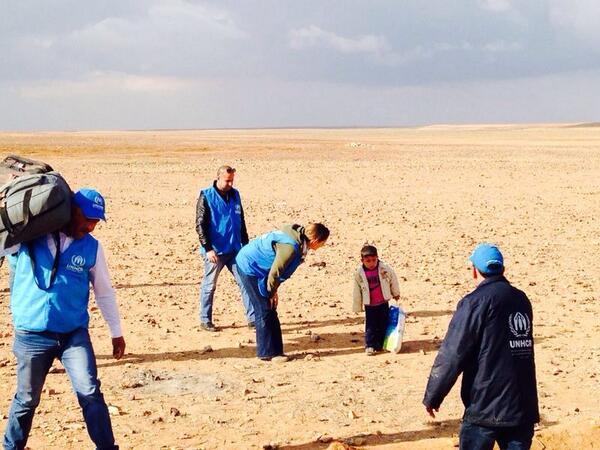
View image on Twitter


     This picture hit the headlines on the Internet two weeks ago. Andrew Harper, the head of the UN refugees agency UNHCR in Jordan, posted it on Twitter. The lead paragraph said: Powerful image of a 4-year-old Syrian refugee boy alone in the desert. In the end the child was only a few feet away from his family. Anyway, despite of the fact that the boy was not alone, this image is overwhelming. The UN reports that more than 2.5 million Syrians have fled their homes since the outbreak of civil war in March 2011. Half of these refugees are children.
     I can’t imagine how confused the boy had to feel, wandering around the desert, plodding through the sand, following the crowd of Syrians who attempted to reach the Jordan border in desperation. The image of such a little boy holding a plastic bag is beyond all understanding.
     Unexpectedly, a different child came to my mind. It was Linus van Pelt, one of Charlie Brown’s friends. In Spain we knew Charlie as “Carlitos” and when I was a little girl I used to read Peanuts comic strip. Linus, dominated by his insecurities, is always depicted holding his old blue blanket while sucking his thumb He called it his “security and happiness blanket”. Then I searched in my computer for an image of him. I found out loads of psychological theories and scientific researches on this sort of objects. Known as “comfort objects”, they may take the form of a blanket, a stuffed animal or a favourite toy. They may be referred to by English-speaking toddlers as blankey and lovely. My interest on the subject was on the increase and I found new words related to this semantic field…blanky, wubby, jointness, transitional object, pacifier (a whole page on the benefits of this item that I had always known as a dummy).

     Finally, I stumbled upon the definition of Comfort Object: ”Item used to provide psychological comfort, especially in unusual or unique situations”. However, I couldn’t find among these objects a plastic bag. I felt miserable remembering Marwan, the little boy carrying his belongings in a huge plastic bag, crossing at Hagallat into Jordan, into an uncertain future.


Wednesday, 12 February 2014

     Speaking exams: What to do

     This is the blog where you can find some interesting videos in which English students are taking oral examinations. As I told you yesterday, they are quite useful and contain some practical tips to tackle the speaking test.


http://davidbradshawenglish.org/2013/05/27/speaking-exams-what-to-do-and-what-to-avoid/

Tuesday, 4 February 2014

     Last Thursday we talked in class about different NGOs. My personal choice was Proyecto Hombre. This organization was created in Spain in 1984 and deals with prevention, treatment and rehabilitation of people with drug dependence and addiction problems. The different centres share their mutual experience, working on a basis of mutual support and cooperation as well as sharing training and research. However, the most important point is that the organization tries to recover the individual, helping the whole person to discover the sense of freedom and responsibility.If you want to know more about Proyecto Hombre…   

http://proyectohombre.es/