Thursday, 6 March 2014

Quiche Lorraine

  Last Tuesday our English class dealt with cooking. We watched a video from the BBC which made our mouths water. It was partly due to the late hour but, above all, to the delicious aspect of the Quiche Lorraine that was being prepared by the lively girl. She easily formed a firm dough in an old porcelain washbasin which, by the way, was quite beat-up. “How easy!” I thought. At that very moment I decided that I had to prepare myself a Quiche Lorraine. It was crystal clear that it wasn’t her first quiche but, anyway, it seemed so easy…
     Idleness is the root of all evil, thus having a couple of free hours I got down to work yesterday. I watched the video again and tried to observe carefully every step. The filling was very easy to prepare but the pastry was something else. Once the dough was ready, the task of rolling it out to form a thin pastry, rolling and rolling out with the rolling pin to get it larger than the diameter of the tart tin, was not a simple task. Next time I’ll buy a ready-made shortcrust pastry in a supermarket.
     The thing is that, fortunately, I got a delicious soft crusty Quiche Lorraine. Don’t you fancy cooking one?

Monday, 3 March 2014

Review. The sailor-boy's tale

     Isak Dinesen’s “The Sailor-Boy’s Tale” was first published in 1942 in Winter’s Tales, a collection of short stories. It is narrated in the style of a fairy tale, a fact that is marked both by the word “tale” used in the title, enlightening the reader as to accept the possibility of strange and unlikely events, and by the ending line “ Simon lived to tell the story”.

     Simon, a young sailor boy, rescues a falcon which was tangled in the ropes of the main mast of a ship. Two years later, Simon is working in a different ship and he goes ashore at a port town on the northern coast of Norway. There he meets Nora, a very young girl who promises to give him a kiss if he comes back the next day. Unfortunately the next day he accidentally kills Ivan, a Russian sailor who he had known some days before. Simon runs to Nora, who gives him the promised kiss. When he is being pursued by some men, Sunniva appears to help him. She is an old woman who explains Simon that she herself was the falcon he had rescued and that now she is rescuing him in return. One particular strength of the book is the supernatural element that appears in the teenager’s life, struggling in the dangerous and unpredictable world of sailors.

     However, if you are not a devoted reader of sailors’ tales, don’t be put off by the title. The story does more than simply trace the story of a young sailor: it provides a fascinating insight into the coming of age of a teenager who goes through a rite of passage to make the transition from boyhood to manhood.


     “The Sailor-Boy Tale’s” is an excellent read. It is both beautifully written and entertaining and I would highly recommend the story to anyone interested in fantastic tales.

Tuesday, 25 February 2014

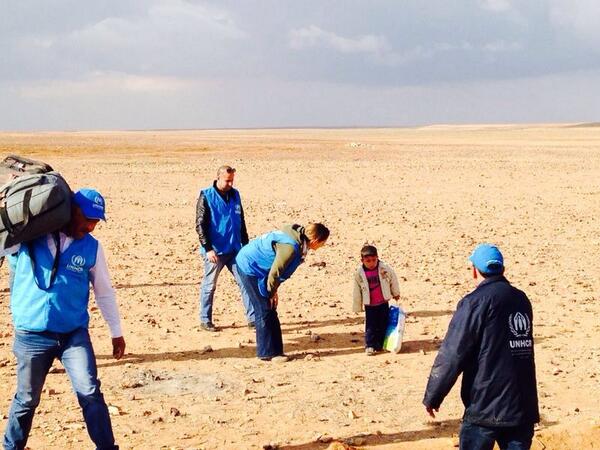
Marwan: A whole life in a plastic bag

Marwan: A whole life in a plastic bag
View image on Twitter


     This picture hit the headlines on the Internet two weeks ago. Andrew Harper, the head of the UN refugees agency UNHCR in Jordan, posted it on Twitter. The lead paragraph said: Powerful image of a 4-year-old Syrian refugee boy alone in the desert. In the end the child was only a few feet away from his family. Anyway, despite of the fact that the boy was not alone, this image is overwhelming. The UN reports that more than 2.5 million Syrians have fled their homes since the outbreak of civil war in March 2011. Half of these refugees are children.
     I can’t imagine how confused the boy had to feel, wandering around the desert, plodding through the sand, following the crowd of Syrians who attempted to reach the Jordan border in desperation. The image of such a little boy holding a plastic bag is beyond all understanding.
     Unexpectedly, a different child came to my mind. It was Linus van Pelt, one of Charlie Brown’s friends. In Spain we knew Charlie as “Carlitos” and when I was a little girl I used to read Peanuts comic strip. Linus, dominated by his insecurities, is always depicted holding his old blue blanket while sucking his thumb He called it his “security and happiness blanket”. Then I searched in my computer for an image of him. I found out loads of psychological theories and scientific researches on this sort of objects. Known as “comfort objects”, they may take the form of a blanket, a stuffed animal or a favourite toy. They may be referred to by English-speaking toddlers as blankey and lovely. My interest on the subject was on the increase and I found new words related to this semantic field…blanky, wubby, jointness, transitional object, pacifier (a whole page on the benefits of this item that I had always known as a dummy).

     Finally, I stumbled upon the definition of Comfort Object: ”Item used to provide psychological comfort, especially in unusual or unique situations”. However, I couldn’t find among these objects a plastic bag. I felt miserable remembering Marwan, the little boy carrying his belongings in a huge plastic bag, crossing at Hagallat into Jordan, into an uncertain future.


Wednesday, 12 February 2014

     Speaking exams: What to do

     This is the blog where you can find some interesting videos in which English students are taking oral examinations. As I told you yesterday, they are quite useful and contain some practical tips to tackle the speaking test.


http://davidbradshawenglish.org/2013/05/27/speaking-exams-what-to-do-and-what-to-avoid/

Tuesday, 4 February 2014

     Last Thursday we talked in class about different NGOs. My personal choice was Proyecto Hombre. This organization was created in Spain in 1984 and deals with prevention, treatment and rehabilitation of people with drug dependence and addiction problems. The different centres share their mutual experience, working on a basis of mutual support and cooperation as well as sharing training and research. However, the most important point is that the organization tries to recover the individual, helping the whole person to discover the sense of freedom and responsibility.If you want to know more about Proyecto Hombre…   

http://proyectohombre.es/

Sunday, 19 January 2014

     Proyecto Hombre, from its inception, has viewed familiy as one of its basic "pillars" in terms of functioning, support and recuperation of the individual. They focus on a comprehensive treatment based on a model capable of diversifying its responses, while considering a great individualization in treatment through work plans that are more adapted to each person.
      Theoretical models and practical programmes based on genuine prevention are those that help the whole person to discover the sense of self-respect and respect for others, the sense of freedom and responsibility, the value of ethical life(truthfulness, honesty), communication and meeting with others, real pleasure and real suffering.
     "Practical problems are not solved when I know the solution but when I put it into practise, which usually is the hardest part..."
 José Antonio Marina.  


I GOT PUZZLED WHEN I KNEW THAT I HAD TO CATCH UP ON MY BLOG!!

            I've been so busy these days...but today I'll try to do all my pending matters.To start with, I have to give my personal point of view on my favourite chapters on the book Mandela's way.Let's begin now...
     Chapter number 1 has been one of my favourite ones, due to its logical. People confuse many times courage to absence of fear. I have always believed that the most important point to achieve goals is to devote yourself to look for them. It doesn't matter if you are afraid of facing difficult situations, essentially we are able to do many things. Fear paralyses us, particularly the fear to be wrong. There is a Spanish proverb that says that who doesn't go on board won't feel sick.Quotting Mandela "Pretend to be brave and you not only become brave, you are brave".
     Chapter 7 "See the Good in Others" is also very educationalist. Nobody isn't absolutely bad nor absolutely nice. It is your personal interest in approaching a human being that makes the difference. Bearing malice against somebody is a feeling that finally will turn against yourself. Easy, isn't it? The thing is that Mandela was in jail for 28 years and he confessed that he didn't feel resentement against anybody."Some call it a blind spot, others naïveté, but Mandela sees almost everyone as virtous until proven otherwise", says Richard Stengel.
     Finally, because I had to choose just three of the chapters, I would select chapter 15 " Find your Own Garden". It is so important to a person having a reason to get up every morning! Looking after plants and pets is an important motivation. We musn't forget that a prisoner has few things to do along his journey. I can try to put myself in an imprisoned person place and the image is this of somebody facing monotony for centuries. A scheduled rutine one day after another, one year after another...How dull!.Mandela was very fond of his garden. For him, keeping a garden not only quieted his mind but also was a place of renewal."The main thing is that each of us needs something away from the world that gives us pleasure and satisfaction, a place apart".  

THE AUTHOR WITH HIS SONS AND MANDELA. 


     My reading has not been easy, I don't refer to  words or to English, as in my opinion this is a very easy book to read. But, since the beginning I detected a sort of Stengel's veneration for Mandela. Anything amazing if we take into account the great personality and enriching experiences of Mandela.  As a human being he had many contradictions. Robben Island became the crucible which transformed Mandela. Through his natural intelligence, charm and dignified defiance, Mandela eventually bent even the most brutal prison officials to his will, assumed leadership over his jailed comrades and became the master of his own prison. He emerged from it the mature leader who would fight and win the great political battles that would created a new democratic South Africa.
     He was an extremely assertive person, having a presence which was immediately noticeable in any group he went amongst. With an aristrocatic background he had been grown up as a chief, and that was his demeanor.
      To sum up, I have learned for the book how important is the desire to better yourself. Unfortunately, life usually tries your patience. This is the lesson that I haven taken from the book, it doesn't matter how hard you have to struggle against difficulties, be honest.


                                                               C H A R I T Y


     I can't of course forget the hard and sad situation of many people who are living in poverty. However, if I admire Proyecto Hombre is because this association is the answer to another hard reality: the one of people suffering from dependences. This is the answer to a real fact: we can all be wrong during our life but we have the right to be forgiven. They are common people who, in a precise time of their lives, chose a wrong way. Their families find themselves unable to overcome the situation. Proyecto Hombre helps addicted and their families with the support of a multidisciplinary team. There are also many voluntaries who help them to incorporate to "normal" life.They just want them to get over their dependence.

   What are the most frequent addictions treated in Proyecto Hombre?

     Althoug there are users suffering from addiction to gambling, most of them suffer from the use of substances: alcohol, heroine, cocaine, psychoactive substances (speedball, scrambled, cannabis) amphetamines and benzodiazepines.